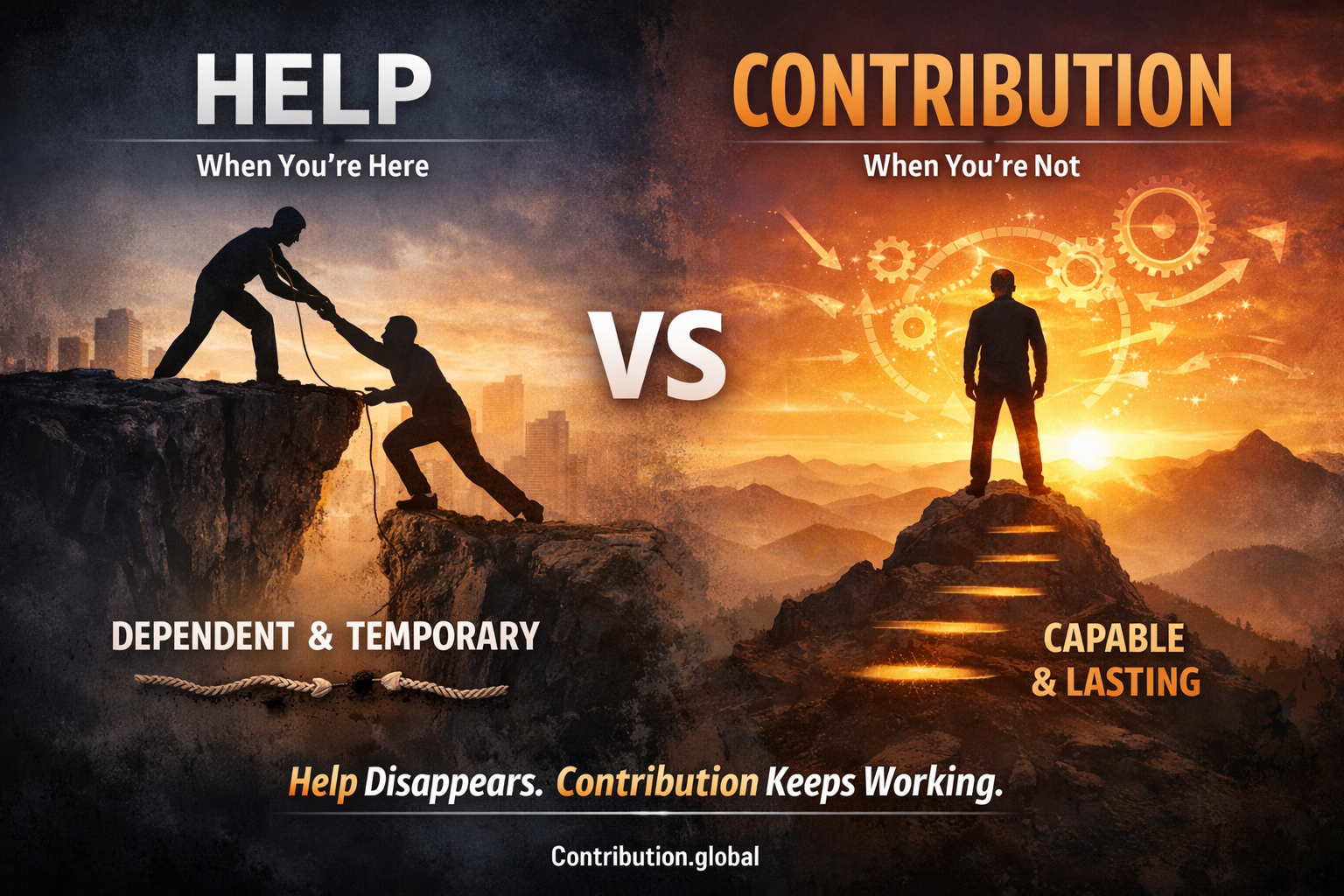
Most people help. Very few people contribute.
There’s a moment most of us have experienced but rarely name.
Someone did something for you years ago. Maybe they explained a concept. Maybe they showed you a different way to approach a problem. Maybe they just asked you one question that reframed everything.
And now, years later, you still use what they gave you.
Not because you’re trying to remember them. Not out of gratitude or obligation. But because what they did changed what you’re capable of.
That’s not help. That’s contribution.
Most people don’t understand the difference. They think ”helping” and ”contributing” are the same thing. They’re not even close.
Help is what you do. Contribution is what remains.
The Problem: We’ve Been Measuring the Wrong Thing
We live in a culture that celebrates effort, intention, and action.
Someone spends hours explaining something to you? They helped.
Someone gave you feedback on your work? They helped.
Someone was there when you needed them? They helped.
And all of that is true. But here’s what we miss:
If nothing changes in what you can actually do—did anything real happen?
Think about it.
You’ve sat through hundreds of meetings. Some felt productive. Some felt like a waste of time. But six months later, how many of those meetings changed what you’re capable of?
You’ve had countless conversations. Some inspiring. Some draining. But how many left you able to do something you couldn’t do before?
You’ve consumed endless content. Articles, videos, courses, podcasts. But how much of it translated into lasting capability?
Not inspiration. Not motivation. Not feeling good in the moment.
Actual capability that persists when the moment passes.
This is the shift most people never make. They confuse activity with impact. Presence with permanence. Good intentions with actual change.
Contribution doesn’t sit in what you did. It sits in what the other person can now do without you.
Test #1: ”Can You Still Do It?”
Here’s the brutal question that reveals everything:
Can you still do it, six months later, without me?
Not: Did you feel helped?
Not: Did you appreciate what I did?
Not: Did it seem useful at the time?
But: Can you still do it?
This is a binary test. Either capability persisted, or it didn’t.
Think about the last time someone ”taught” you something. Maybe it was a skill, a framework, a way of thinking. In the moment, it seemed valuable. You nodded. You said ”that makes sense.” Maybe you even tried it once or twice.
But six months later—can you still do it? Without looking it up? Without asking for help? Without needing the original person there to guide you?
If yes: contribution happened.
If no: something else happened. Maybe help. Maybe inspiration. Maybe performance. But not contribution.
This test is harsh because it exposes how much of what we call ”impact” evaporates the moment conditions change.
Real Examples:
You took a course. You passed the test. But three months later, you can’t remember how to apply what you learned. That wasn’t contribution—it was information you temporarily held.
Someone gave you advice that felt profound. You thanked them. You felt grateful. But when you faced a similar situation later, you couldn’t remember what they said or how to apply it. That was a moment, not a change.
A colleague helped you solve a problem. But the next time that problem appeared, you had to ask them again. They didn’t make you more capable—they made themselves necessary.
This is uncomfortable because it forces us to confront the gap between what we think we’re doing and what we’re actually creating.
But it’s also liberating. Because once you see the difference, you can start optimizing for the thing that actually matters.
Not: ”Did I help?”
But: ”Did I change what they can do?”
The Uncomfortable Truth: Most Help Disappears
Here’s what nobody wants to admit:
Most of what we call ”helping” creates dependency, not capability.
A manager who solves every problem for their team isn’t building capability—they’re creating reliance. The moment they leave, everything they ”helped” with collapses.
A parent who does their child’s homework isn’t contributing to learning—they’re preventing it. The child passes the assignment but gains no lasting skill.
A consultant who implements the solution without transferring understanding isn’t adding long-term value—they’re ensuring they’ll be needed again.
All of these feel like help in the moment. But the test is simple:
What happens when you’re not there?
If the answer is ”everything stops working,” then you didn’t contribute. You created a performance that required your presence.
Let’s get specific:
You’ve probably worked with someone who was brilliant at their job but terrible at enabling others. Every decision ran through them. Every problem required their input. They were the bottleneck disguised as the hero.
When they were there, things worked. When they weren’t, chaos.
That’s not contribution. That’s control masquerading as competence.
Or think about the friend who always gives great advice. You call them when you’re stuck. They tell you exactly what to do. You feel better. You follow their suggestion. It works.
But the next time you’re stuck, you call them again. Because they didn’t teach you how to think through problems—they just solved this one specific instance.
That’s help. It’s valuable. It’s kind. But it’s not contribution because it doesn’t increase your independent capability.
Now contrast that with someone who, when you ask for advice, asks you questions instead. They don’t tell you what to do. They help you see the situation differently. They reveal assumptions you didn’t know you were making.
At first, this feels less helpful. You wanted an answer, and they gave you more questions.
But six months later, when you face a completely different problem, you find yourself asking the same kinds of questions. Their framework became yours. That’s contribution.
This is the difference between:
Presence-dependent impact: You were there, so things worked.
Structure-dependent impact: You changed something, so things keep working.
Presence-dependent impact feels good. You feel needed. People thank you. You get credit. But it’s fragile. It disappears the moment you do.
Structure-dependent impact doesn’t require your continued presence. It survives separation. It persists across time.
Help disappears when you leave. Contribution keeps working.
The Counterintuitive Truth: When You’re No Longer Needed, You Succeeded
This goes against everything modern work culture teaches us.
We’re taught to be indispensable. To make ourselves necessary. To build personal brands, own processes, become the go-to person.
But here’s the truth:
The best contribution makes you obsolete.
Think about the best teacher you ever had. The one who fundamentally changed how you think. What did they do?
They didn’t make you dependent on them. They didn’t build a system where you needed their approval for every decision. They didn’t create a situation where you had to keep coming back.
They gave you a way of thinking. A framework. A lens. And then they let you run with it.
Months or years later, you still use what they taught you. But you don’t need them anymore. You internalized it. It became part of how you operate.
That’s the highest form of contribution. Not ”you’ll always need me.” But ”you won’t need me anymore—and that’s the whole point.”
This applies everywhere:
A good parent doesn’t raise a child who can’t function without them. They raise someone who becomes independent.
A good mentor doesn’t create disciples who need constant guidance. They create people who can think for themselves.
A good leader doesn’t build a team that collapses without them. They build a system that runs itself.
The measure of contribution isn’t how much people need you. It’s how much they can do without you.
This is terrifying for people who derive their sense of value from being needed. But it’s the only way to create something that lasts.
If your value comes from people’s dependency, you haven’t contributed. You’ve created leverage.
If your value comes from what people can now do independently, you’ve created something permanent.
Why Gratitude Isn’t Proof
Here’s another uncomfortable truth:
Someone can thank you profusely—and still have gained nothing lasting.
We conflate emotional response with actual change. But they’re not the same.
You’ve experienced this. Someone gave you advice. You felt grateful. You thanked them. It felt meaningful in the moment.
But three months later—did it change anything? Can you do something new? Or was it just a nice moment that passed?
Gratitude is a signal. But it’s not proof.
People say ”thank you” for many reasons:
- You made them feel heard
- You gave them hope
- You validated something they already believed
- You made them feel better temporarily
All of those are valuable. But none of them necessarily mean capability changed.
The real test isn’t: ”Did they thank you?”
The real test is: ”Can they do something now that they couldn’t do before you showed up?”
This distinction matters because it shifts what you optimize for.
If you optimize for gratitude, you’ll do things that feel good in the moment. You’ll give advice. You’ll be encouraging. You’ll make people feel better.
And all of that is fine. But it’s not the same as contribution.
If you optimize for capability transfer, you’ll do something harder. You’ll teach frameworks, not answers. You’ll create understanding, not just information. You’ll build lasting skill, not temporary confidence.
The difference:
Gratitude says: ”You were there for me.”
Contribution says: ”You changed what I can do.”
The first is about presence. The second is about permanence.
Both have value. But only one creates something that survives beyond the moment.
You Didn’t Give Me Answers — You Gave Me Direction
Think about the people who genuinely changed your life.
Did they give you answers? Or did they give you a way of finding answers?
Did they solve your problems? Or did they change how you think about problems?
Did they tell you what to do? Or did they shift your entire framework for making decisions?
The most powerful contributions aren’t information dumps. They’re not step-by-step instructions. They’re not answers to specific questions.
They’re shifts in how you think.
Someone teaches you to think in systems instead of isolated events—and suddenly you see patterns everywhere.
Someone shows you how to ask better questions instead of just accepting information—and your entire learning process changes.
Someone helps you reframe failure as data instead of evidence of inadequacy—and your relationship with risk transforms.
None of these are ”answers.” They’re direction.
And direction is far more valuable than answers because it compounds.
An answer solves one problem. Direction solves infinite problems.
An answer is static. Direction adapts.
An answer expires when conditions change. Direction persists.
Here’s a real example most people have experienced:
Early in your career, you ask someone: ”How do I handle this difficult conversation with my boss?”
Response A (Answer):
”Say this: ’I appreciate your feedback, and I’d like to discuss how we can move forward.’ Then follow up with an email summarizing the key points.”
You use it. It works. But the next difficult conversation is different, and you’re stuck again.
Response B (Direction):
”Before any difficult conversation, I think through three things: What outcome do I actually want? What does the other person need to hear to get there? What assumptions am I making that might not be true? Once you have clarity on those, the words usually come naturally.”
The first gives you words. The second gives you a framework.
Six months later, you’re facing a completely different difficult conversation—with a client, a colleague, a family member. The specific words from Response A are useless. But the framework from Response B? You’re still using it.
That’s the difference between answers and direction.
This is the difference between teaching someone to fish and giving them a fish—but deeper.
Giving them fish = answering their question
Teaching them to fish = showing them how to answer that type of question
But the real contribution is:
Changing how they think about the river, the ecosystem, sustainability, when fishing even makes sense, and what they’re actually trying to accomplish.
That’s the level where real contribution happens. Not answers. Not even skills. But frameworks. Ways of seeing. Mental models that persist and compound over time.
The scary part? Giving direction is harder than giving answers.
Answers make you look smart immediately. Direction takes time to show value.
Answers get immediate gratitude. Direction often gets confused frustration at first.
Answers feel complete. Direction feels open-ended.
But answers disappear. Direction lasts.
So when someone asks you for help, ask yourself:
Am I about to give them an answer that solves this one instance?
Or am I about to give them a way of thinking that solves this entire class of problems?
The first is easier. The second is contribution.
What This Means for You
If you’re reading this and feeling uncomfortable, good.
That discomfort means you’re seeing the gap between what you thought you were doing and what you’re actually creating.
Most of us think we’re contributing when we’re just being active. We confuse motion with impact. We mistake presence for permanence.
But once you see the difference, you can’t un-see it.
You start asking different questions:
Not: ”Did I help?”
But: ”What can they do now that they couldn’t do before?”
Not: ”Were people grateful?”
But: ”Six months from now, will anything be different?”
Not: ”Was I useful?”
But: ”Am I still necessary—or did I make myself obsolete?”
These questions are harder. They require honesty. They don’t give you the immediate dopamine hit of feeling helpful.
But they point toward something more valuable than feeling good. They point toward creating something that lasts.
The shift in three parts:
Before: I helped a lot of people today. I feel productive.
After: Did I change what anyone can do? Or did I just create temporary performance?
Before: People thanked me. That means I made a difference.
After: Can they still apply what I showed them six months from now without me?
Before: I’m valuable because people need me.
After: I’m valuable when people don’t need me anymore—because I changed what they’re capable of.
The Real Test
Here’s how you know if you’ve contributed:
Time passes. Conditions change. The person is in a completely new context.
And they can still do the thing you helped them understand.
Not because they’re trying to remember you. Not out of gratitude. Not because you’re there to help.
But because it became part of how they operate.
That’s contribution.
Everything else—no matter how helpful, kind, or well-intentioned—is something else.
And that’s okay. Not everything has to be contribution. Sometimes people just need support. Sometimes they need encouragement. Sometimes they need someone to be present.
But if you want to create something that lasts, if you want your impact to survive beyond your presence, if you want to genuinely change what someone is capable of—
Then you need to stop optimizing for help and start optimizing for capability transfer.
You need to ask: ”What will remain when I’m gone?”
What Changes When You See This
Once you understand the difference between help and contribution, everything shifts.
You stop collecting thank-you notes and start tracking whether people can still do it six months later.
You stop trying to be indispensable and start trying to make yourself obsolete.
You stop giving answers and start building frameworks.
You stop optimizing for the moment and start optimizing for what persists.
This doesn’t mean you stop being kind. It doesn’t mean you stop being helpful. It doesn’t mean you become cold or transactional.
It means you start asking: ”Am I creating dependency or capability?”
And when the answer is dependency, you adjust.
Because the world doesn’t need more people who help in the moment.
The world needs people who change what others are capable of.
Contribution is what remains when you’re gone.
Not what you did. What remained.
Not what you gave. What they kept.
Not how you helped. What they can now do without you.
Help needs you. Contribution survives you.